
A Pilot Randomised Control Trial (RCT) Protocol to Compare Additional Information on Neonatal Body Water Distribution (RAINBoW) with Standard Care

Abstract
Background: Intravenous fluid provision is an integral part of neonatal care, the success of which has implications for both short- and long-term outcomes of the infant. Fluid management decisions are currently based upon a combination of laboratory and anthropometrical measurements. These dynamic decisions are made problematic due to continually fluctuating clinical measures.
Aim: The aim of this project is to determine if additional bioelectrical impedance data on neonatal body water distribution (RAINBoW) provided to the clinical team impacts on clinical outcomes compared with standard care, in a pilot trial.
Participants: All neonates admitted to a single Neonatal Intensive Care Unit (NICU) within 24 hours of birth and likely to require complex fluid management in the first week of life will be eligible. They will be stratified age; < 30 weeks, 30-36 weeks and 37 weeks and above.
Methods: 170 Infants will be randomised to have a bioelectrical impedance assessment (BIA) reading taken daily for 28 days and weekly until discharge, (made available to clinicians who are making fluid management decisions) or standard care with no BIA. Observations of ward rounds and interviews with staff and parents will be embedded into the study.
Outcomes: The primary clinical outcome is change in serum sodium, measured by deviation outside normal range 132-143 mmols/l within the first 14 days of life. Secondary outcomes relate to the presence of preterm morbidities, as well as outcomes important to NICU parents; length of respiratory support, length of time taken to achieve full feeds and length of hospital stay. Trial feasibility, the perceived clinical utility and added value of BIA will also be explored.
Qualitative Outcomes will include staff insight regarding adherence to the intervention arm (through observations and feedback completion), staff perception of the clinical utility of BIA and parental acceptability of BIA.
Trial Registration: The trial has been prospectively registered on 15/11/24 at: ISRCTN, No: 68426208.
Article Information
- Received
- Accepted
- Published
Academic Editor: Anubha Bajaj, Consultant Histopathologist, A.B. Diagnostics, Delhi, India.
Checked for plagiarism: Yes
Review by: Single-blind
Copyright © 2026 D.L. McCarter, et al.
 This is an open-access article distributed under the terms of the Creative Commons Attribution License, which permits unrestricted use, distribution, and reproduction in any medium, provided the original author and source are credited.
Diane Lesley McCarter, Advanced Neonatal Nurse Practitioner, Neonatal Intensive Care Unit, Liverpool Women’s Hospital, Crown St, Liverpool, L8 7SS, United Kingdom and Postgraduate Researcher, Edge Hill University, Faculty of Health, Social Care & Medicine, Ormskirk, L39 4QP, United Kingdom ,
Competing Interests
There are no conflicts of interest from any of the detailed authors associated with this project
Funding
This study is sponsored by the Liverpool Women’s Hospital. Support from the trust has been provided in the form identified research time for the principal investigator, who is completing this work as part of a PhD study. The equipment has been provided by the trust as has academic supervision. There has not been any external financial funding for this project.
Data Availability
All data for the final study will have been a product of the RAINBoW study. Consent to publish this data will have been granted during the consent process. Data will be available on request.
Citation:
Background
For a preterm, or fragile new-born the success of their following development and resulting outcome lie in the hands of the multidisciplinary team (MDT). The aim of successful neonatal care is to achieve growth in the outside world, as would be expected if the infant remained in utero 1. Fluid administration in the neonatal period should allow for contraction of the extracellular fluid (ECF), permitting a period of negative sodium and water balance; this is part of normal extrauterine adaptation 2. The complexity of neonatal fluid management is a challenge to both the medical and nursing staff. The multifaceted decision-making process relies upon the collaboration of the multidisciplinary team (MDT). Accurately assessing the quickly evolving fluid status of the infant is a clinical challenge and with risks for survival and/or complications 3. Fluid overload has been found to be associated with electrolyte disturbances and increased risk of unfavourable outcomes such as bronchopulmonary dysplasia (BPD), intraventricular haemorrhage (IVH), necrotizing enterocolitis (NEC), hemodynamically significant patent ductus arteriosus (PDA) and acute kidney injury (AKI) 4, 5. Fluid restriction however has been associated with an increased risk of dehydration 6. Accurate fluid balance is problematic within the NICU 5 and preterm physiology can impact upon the intricacies of this. Preterm/sick infants are at increased risk of capillary leak leading to fluid moving out of the veins and into the interstitial space 5. Immature skin can lead to excessive trans epidermal water loss 7, and there is a risk of fluid imbalance due to their underdeveloped kidneys 4.
Clinicians currently use a mixture of clinical examinations, physiological measurements (e.g., body weight, fluid balance, blood pressure, heart rate, capillary refill, skin turgor), laboratory investigations (serum electrolytes) and echocardiograms to try and determine whether the baby has too little, too much or the right amount of fluid in the body 8. Sodium and water loss are entwined as water moves via osmosis to maintain equilibrium 9. Serum sodium is used within NICU as a marker for hydration status. Hypernatremia in conjunction with a negative fluid balance and/or weight loss is often attributed to fluid insufficiency 10. Hyponatremia in conjunction with weight gain and/or insufficient urine output/positive fluid balance can be attributed to fluid overprovision or failure of normal physiology to bring about extracellular fluid loss within the first few days of life 10. Serum sodium however may also be affected by gastrointestinal losses, provision of blood products, drug administration or endocrine conditions. Over or under provision of supplements to maintain sodium requirements needed for growth may also impact upon laboratory markers. In addition, the newborn infant transitions through phases of oliguria, sodium, and water retention and into a period of diuresis 10 which enhances complexity. The MDT must consider all these factors when evaluating fluid status. This interpretation of multiple physiological and clinical parameters leads to variations in fluid and electrolyte management between clinical staff. In some infants the clinical picture can change dramatically within a few hours, adding urgency to the scenario.
Multi-frequency Bioelectrical Impedance (BIA) can accurately measure fluid within various body compartments. BIA is a non-invasive and innocuous method of quantifying body composition and total body water (TBW) volume in children and adults 11. Measuring the sum of a body compartment is grounded in the theory that different biological tissues conduct electricity at various rates due to their differentiating ionic content 12. Highly conductive components are made up of large amounts of water and electrolytes, lean tissue, ECF and muscle. Bone, body organs and fat have insulative properties and are poor transmitters of electricity 12.
Previous studies using BIA have focused on the validation of algorithms for assessing total body composition 13, 14 and Fat Free Mass (FFM) 15. There is a paucity of studies which focus upon fluid volumes such as total body water (TBW), extracellular water (ECW) intracellular water (ICW), intravascular Fluid (IVF) and extravascular fluid (EVF). In current NICU practice there is a lack of objective body fluid distribution measurements, particularly between the intravascular, intracellular, and extracellular compartments, to allow objective and consistent decision making. It is proposed that these are areas of focus could bring benefits to the neonatal population and those caring for them. This is especially true with the increasing survival of extreme preterm infants.
It is hypothesised that the information from BIA about body water content has the potential to improve decision making regarding fluid management in very premature babies and may impact on mortality and morbidity. Thus, this is a protocol for a pilot Randomised Control Trial (RCT) with embedded qualitative study to establish if it is feasible to incorporate BIA data into the clinical decision-making in NICUs and whether it impacts upon clinical outcomes.
Methods
Design and Aim
RAINBoW is a pilot superiority randomised control trial (RCT) with embedded qualitative study. The aim is to determine if BIA data on neonatal body water distribution (RAINBoW) provided to the clinical team impacts on clinical outcomes compared with standard care (no BIA). The study will also explore any perceived value that BIA measurements bring to the decision-making process and clinical care. The data produced by this pilot study will be used to aid the design of a larger, more definitive trial in the future.
The research question is, in infants in the NICU who are receiving intravenous fluids for at least 7 days (Population), does the provision of daily bioelectrical impedance measurements (Intervention) assist the clinician in making fluid management decisions, compared to standard care (not providing this data) (Comparison) and impact on the stability of serum sodium levels (clinical outcome).
Screening and Randomisation
Infants admitted to the participating NICU will be screened for inclusion (Table 1).
Table 1. Inclusion and Exclusion Criteria| Inclusion Criteria | Exclusion Criteria |
|---|---|
| Admitted to the NICU within 24 hours of birth | Have a life limiting condition and the prognosis is that they will not survive the first week of life |
| Expected to require intravenous fluid management for the first week of life | |
| Infants will be stratified by age and condition as follows | Being nursed in isolation for maternal/infant infection, that prevents the device from being used (contamination risk) |
| Preterm Infants <30 weeks gestation | |
| Preterm infants 30-36 completed weeks gestation | Parents who are unable to understand study information and are deemed unable to make an informed decision to opt out. |
| Infants 37 weeks and above, requiring intensive care in the first 24 hours of life |
Infants will be randomized on a 1:1 basis to either ‘BIA’ or ‘Standard Care’ using the Sealed Envelope randomisation TM software. The screening and randomisation will be done by the nurse in charge, nurse practitioner or consultant. Randomisation, will be stratified according to the infant’s initial group identification; < 30 weeks, 30-36 weeks and 37 weeks and above. This will be three strata and block sizes of 2 and 4, giving a mean imbalance of 0.9 (Sealed Envelope TM software, 2024). Information regarding randomisation sequence and block size will not be available to the clinical team. For multiple births, one randomisation will be carried out, with siblings being allocated to the same arm of the study. Infants will be pseudo anonymised on enrolment and given a unique study number. The service will be available 24 hours a day, seven days a week. Randomisation will occur within 24 hours of birth.
For the primary outcome, serum sodium levels will be monitored for deviations outside the normal range (the neonatal target sodium levels are described in our NICU guidelines as 132 mmol -143 mmol/L). The daily deviation from the normal range (perturbation), will be combined in a cumulative total over the first 14 days and generate the SP14 mmol/L (sodium perturbation over first 14 days of life). One perturbation value will be calculated for each day. Where more than one value is available in a 24-hr period, the value most outside the normal range will be counted. Missing daily values will be extrapolated from sodium data on the days before and after, assuming a linear trend. The study team were able to use the plasma sodium data from 150 infants recorded over the first 14 days of life in an earlier study (16), to calculate the median SP14 for this population of infants <29 weeks gestation. This provided the data used for the power calculation. This clinical primary outcome has been chosen because plasma sodium management is both an important individual outcome and because it a key component of assessing early neonatal fluid status.
Secondary outcomes relate to both secondary clinical outcomes, BIA clinical utility and trial feasibility (Table 2).
Table 2. Trial Outcome Measures| Outcome | Measurement | |
|---|---|---|
| Clinical Primary Outcome | Change in Serum Sodium (sodium perturbation) | Deviation Outside Normal Range 132-143 mmols/l within the first 14 days of life |
| Clinical Secondary Outcomes | 1. Body Water Distribution (Intervention Arm Only) | 1. ECF/ICF/IVF/EVF/ E: I Ratio |
| 2. Daily Nutritional Intake | 2. IV/Enteral Nutrition Volume/Constituents (ml/mmols/mg/G) (Protein/Lipid/Glucose) | |
| 3. Mean Daily Glucose | 3. Mean Total Body Glucose (Blood Gas) | |
| 4. Insulin use | 4. Dose in Units/KG/Hr and Hrs | |
| 5. Growth | 5. Weight (grams)/ Length (cm)/Head Circumference (cm) | |
| 6. Daily Electrolyte Levels | 6. Measured in Values (mmol/l) | |
| 7. Total Body Mineral Content | 7. As per BIA | |
| 8. Mean Serum Mineral Level | 8. Sodium / Potassium / Mg/ Calcium / Phosphate (mmol/l) | |
| 9. Parathyroid Hormone Levels | 9. PTH (Weekly) | |
| 10. Duration of Respiratory Support | 10. Days/Hrs and Mode | |
| 11. Frequency of Circulatory Support | 11. Days/ Hrs /Drugs | |
| 12. Duration of IV Fluid Therapy | 12. Days/Hrs /Type | |
| 13. Adverse Events Associated with IV Fluid Therapy | 13. Skin Injuries as per EPR | |
| 14. Infant Length of Stay | 14. Days/Weeks/Months | |
| 15. Presence of Preterm Morbidities (Mortality/Sepsis/Chronic Lung Disease/Intraventricular Haemorrhage/Acute Kidney Injury/Patent Ductus Arteriosus) | 15. Blood Culture/Cranial Ultrasound/Creatinine/Echocardiography | |
| Feasibility Secondary Outcomes | 1. Patient Recruitment | 1. Total Number Enrolled / Total Opt Out and Mortality Rates |
| 2. Staff Recruitment | 2. Total Number Enrolled | |
| 3. Consent Rates (both) | 3. Total Number Enrolled /Total Opt Out | |
| 4. Completeness / Quality of Data Collection | 4. Total and % Missing and % Poor Quality (Red/Amber Face) | |
| 5. Adherence to Study Protocol (BIA Measurements /Review process) | 5. Total and % Missing | |
| 6. Measures of Clinical Utility | 6. Total and % /Coded Qualitative Feedback | |
The embedded qualitative descriptive study 17 will explore clinicians’ practice ‘in the real world’ as well as parental and clinician reported perceptions of the device. This qualitative descriptive approach aligns with generating rich descriptions of experiences and events without extensive theorisation 18. Interviews and observations will investigate the five aspects of the clinical utility framework outlined below 19, Aspects of the trial design will also be explored in this context.
1. Appropriateness (relevance)
2. Accessibility (Resource implications)
3. Adherence
4. Practicality (Functionality/Suitability/Training)
5. Acceptance (To Clinician/Family)
Parents whose first language is not English will be assisted to understand the information leaflet with the use of electronic translation devices and interpreter services whenever possible for both the RCT and the qualitative element of the study (Table 3).
Table 3. Inclusion and Exclusion Criteria Embedded Qualitative Study| Inclusion Criteria | Exclusion Criteria |
|---|---|
| • Members of the MDT who work clinically in the NICU and participate in the daily ward round | • Members of the MDT who either do not work clinically in the NICU or who do not participate in the daily ward round |
| • Parents of NICU patients who are enrolled in RAINBoW | • Parents who do not have a baby enrolled in RAINBoW |
| • Parents who are unable to understand study information and are deemed unable to make an informed decision take part |
Study Setting
The study will take place in a single NICU in Northwest England, which provides level 3 care to patients of 22 weeks to post-term gestations. The NICU has 42 cots (12 intensive care, 12 high dependency and 18 low dependency) and admits both medical and surgical patients. The unit admits around 1000 babies annually.
Sample Size
The study will recruit 170 preterm or term neonates who are expected to receive intravenous fluid for at least 7 days in the first two weeks of life. This sample size is based on data from a previous study 16. The power calculation was performed and set up to detect a difference of at least 5 mmols/L in the median SP14 for intervention and control groups. To achieve a power of 80% with a probability of 0.05, it was calculated that 85 patients per treatment arm would be required. This sample size does not adjust for participant drop out, as this was expected to be <3% due to the “opt out” design.
Feasibility of Sample Size
Data from electronic patient records indicates that between 150-200 babies would have met the inclusion criteria with a 12-month period. Anticipating a conservative consent rate of 80% (for opt out studies), this would suggest between 120 – 160 babies each year could be recruited, thus in a 24-month data collection period this sample size if feasible.
Standard Hydration Assessment in the NICU
All babies will receive IV fluids provided based on their weight as per NICU guidelines (Appendix 3). Alterations to fluid provision either in line with or outside of the usual guideline will be based upon clinical assessment of hydration status. This will include daily weight, clinical examination of mucous membranes, skin turgor, fontanelle, oedema, capillary refill, plasma sodium level, blood pressure, blood sugar, urine output and fluid balance (Appendix 4). Any echocardiography will also add to hydration assessment by identifying heart filling status. Hydration assessment will occur at least each morning during the ward round but can be as frequent as every 6 hrs in extreme preterm infants. Hydration evaluation and fluid management decisions will be undertaken by the medical and ANNP (Advanced Neonatal Nurse Practitioner) team.
Bioelectrical Impedance Measurement (BIA)
All babies who are randomised to the intervention arm of the trial, will have at least daily bioelectrical impedance measurements taken by the bedside nurse prior to the morning ward round. The BIA readings will be taken using a BioScan touch i8 nano, following a standard operating procedure (Appendix 5), and in line with BIA training that has been provided 20. This dataset (including measurements of TBW, ECF, ICF, IVF trends, EVF trends and overall fluid status) will be made available to the nurse and doctor/ANNP responsible for the intervention group prior to the ward round. The control group will not have a BIA reading taken and therefore this additional hydration status information will not be available to the clinical team.
Hydration evaluation and any change to fluid provision / prescription will be made during the ward round by the team responsible for caring for the infant. Only the intervention arm of the study will have BIA data available for the clinical team. The clinical team have taken part in an associated study which provided focused education about BIA and fluid provision in the newborn 20. If and how the BIA data is utilised by the clinician’s is an important outcome of this study.
Following day 28, the BIA readings will be taken weekly until the time of discharge. Participation in the study ends on the day of discharge. The study data collection period will run over a period of 2 years.
Bioelectrical Impedance Clinical Utility
A BIA clinical utility feedback sheet will be completed by the clinical team during the ward round, for infants who are in the intervention group. This feedback form is based upon the clinical utility model 19 and was developed by the study team. Clinicians will be asked to document their perceived usefulness of the BIA readings and how the data was utilised within the fluid administration decision making. This will be accessed via a QR code which is linked to an electronic version of the form (MS Form) and displayed on the participants incubator (Appendix 6). A reminder to complete the clinical utility feedback sheet will be provided to the clinical team by the PI daily. Missing data and the occurrence of poor-quality readings will be assessed as an outcome at the end of the trial.
Internal Validity of BIA Measurement
Reproducibility of measurements will be tested on each baby during the initial BIA reading, with three separate measurements being taken at 20-minute intervals. A further three measurements will be taken following an hour gap, continuing at 20-minute intervals. If the measurements produced are comparable, the readings will then be taken daily. If the reproducibility measurements are different in terms of extracellular: intracellular ratio (at least by 1) or overall fluid status outcome (categorical outcome), the infant will be re-testing the following day. Regular testing will begin once reproducibility has been confirmed.
Embedded Qualitative Study
Semi-structured ward round observations will take place on the NICU and conform to the normal hospital routine. The ward rounds will be observed by the Principal Investigator (PI). Non-participant observation will be used to note adherence to the study protocol and how the BIA device is used in practice to inform clinical decisions during the ward round. The observation will help address the objectives of examining if: -
· The BIA information is referred to and used in decision-making around fluids
· If the use of BIA highlights new issues
· If the BIA data appeared clinically useful to the clinician
The PI will observe 30 ward rounds in total; 10 from the first third of the study, 10 from the middle third, and 10 from the final third of recruitment.
Qualitative semi-structured interviews will also be conducted to explore clinicians’ perceptions of BIA as a tool to augment the decision-making process regarding fluid management in the NICU. Parental views of the use of BIA within their baby’s care will also be explored. Aspects of trial design (recruitment, consent, data collection and adherence to BIA use) will be explored within these interviews. The clinical utility framework will be used to model observational prompts and interview guides to enable the five aspects of the concept to be examined 19. Semi-structured interviews will be carried out with at least one clinician and one parent from each ward round that was observed, with a target of 30 parent and 30 clinician interviews (Total = 60). Only one parent from each family will be asked to participate. A heterogenous sample of Nurses/ANNPS/Medics/Consultants will be recruited to ensure a maximum variation purposive sample across the MDT and across the different time points of the RCT (Table 3). The maximum variation purposive sample aligns with a qualitative descriptive design in that it acknowledges that a range of experiences are important to include in the investigation 18. The sample size will be determined by the concept of ‘information power’ 21 and the amount of information collected relevant and adequate to answer the objectives of the embedded qualitative study 22. The interviews will be undertaken by the PI. The PI will practice reflexivity throughout the qualitative elements of the study, being particularly self-reflective of the ways in which their clinical/insider role may influence data collection and analysis 23.
Data Management
Infant data will be stored on the BIA device and pseudo anonymised by their unique study identifier. Data will be transferred via a USB drive onto a restricted access, password protected, encrypted hard drive. Interviews will be audio-recorded and downloaded from the device as soon as possible and then deleted from the device. Pseudo-anonymised transcriptions will be created in Microsoft Word as soon as possible after the interview has taken place. Transcriptions will be quality checked by a fellow member of the research team before audio recordings are permanently erased from the computer. Observational data from this phase of the study will be held in a word document or a CVS file. All eCRFs will be pseudo-anonymised using the participants allocated unique study ID and will not contain identifiable information. Outcome data from electronic case notes will be collected, pseudo anonymised and held on a password protected excel spreadsheet.
Statistical Analysis
Primary Outcome
Data will be cleaned and checked before importing into IBM SPSS V29 for analysis. Descriptive analysis will be undertaken first. After this, SP14 values between the two groups will be compared using a two tailed Wilcoxon-Mann-Whitney U test, and the corresponding Hodges-Lehman estimator and 95% confidence intervals will be reported 24. Statistical analysis will not be blinded. Trial data will be reported in line with the CONSORT trial reporting checklist.
Secondary Outcomes
Secondary clinical outcomes will be described and compared between the groups, using either non-parametric test (Chi-Squared) for categorical variables 24, or parametric tests (independent T-Test) for continuous normally distributed variables 24, (Table 2). Secondary feasibility outcomes (recruitment, consent, suitability of inclusion criteria, data collection and adherence to BIA use, actual and missed impact) will be described in terms of percentage and total numbers (Table 2).
Clinical utility feedback data (appendix 6) gathered via the QR codes during the ward round will be presented in terms of percentage adherence. Episodes of increased sodium perturbation will be examined in conjunction with BIA adherence, fluid and electrolyte provision, reported clinical utility and clinical data to establish actual and missed BIA impact.
Qualitative Analysis
Observational notes will be taken on a ward round observation sheet and be retained for analysis, with interviews being audio-recorded and transcribed for analysis. A six-phase analytical process will be followed; familiarization with the data, generating initial codes, generating themes, reviewing potential themes, defining, and naming themes, producing the report 25. Thematic analysis techniques will be employed to analyse the observational field notes first followed by the interview data. The PI will initially analyse the datasets by coding and developing themes 25. Primarily an inductive approach to analysis will be taken to code the data, aligning with the qualitative descriptive design 17, 23. A second stage more deductive content analysis will be carried out to examine for elements of the clinical utility framework 19. A co-investigator will also code this data set to enhance the credibility of this process.
Ethical Approval and Consent to Participate
Ethical approval has been granted by HRA and Health and Care Research Wales (HCRW) and IRAS (IRAS ID 342736) 30/10/2024. The team will conduct the study in compliance with the approved protocol and will adhere to the principles outlined in the Declaration of Helsinki, the sponsor guidelines, and other regulatory requirements.
The ethics committee has approved RAINBoW as an “opt out study”. This consent approach means that any eligible infant who meets the inclusion criteria, will automatically be included in the study unless a parent/legal guardian makes an informed decision on behalf of their baby to “opt out” of participation 26.
To facilitate and informed decision, written participant information will be provided to parents/legal guardians at the time of admission to the NICU by a staff member. This information can also be accessed via study posters which will be visible throughout the NICU. Parent’s will be approached by the research team as close to the first 72 hrs after birth as possible and asked to confirm if they wish for their baby to remain enrolled in the study or that they wish for their baby to “opt out”. If the parent is happy for their baby to be included, this decision will be confirmed as close to day 7-10 as possible. It will be made clear that participation is not mandatory and that their baby’s care will not be affected by their decision regarding involvement in the study. If a parent wishes to “opt out” they will be invited to complete an opt out declaration form. If a parent opts out after 72 hrs, collected data will be included in the analysis. Written, informed consent will be sought by the PI for parent and staff interviews. Verbal consent will be taken by the PI for participation in ward round observations.
Registration
The trial has been prospectively registered on 15/11/24 at: ISRCTN, No: 68426208
Parent Engagement
Parents were involved in developing study information, and all parent-facing material.
Adverse Effects
BIA is non-invasive and as such no significant harms are anticipated. Adverse effects may include potential skin injuries or increased emotional distress of the parent population. These risks will be assessed by the principal investigator and appropriate referrals made. BIA measurements will be taken during routine care time. Judgements about increased handling and infant stability will be made by the clinical team and will form part of the clinical utility feedback.
Dissemination Plans
The mixed methods RCT will form part of the PhD thesis of the principal investigator (DM). The results will also be presented at UK and European Neonatal conferences. It will be written up for publication in a relevant high impact journal. The qualitative findings will be presented in accordance with the GRAMMS framework 27. A lay summary will be prepared in collaboration with our parent group, for sharing with families and on social media to maximise the sharing and awareness of results.
Conclusion
This pilot RCT with embedded qualitative study will be the first to explore the clinical use of BIA and its impact on fluid management decisions and outcomes in the NICU. This information is not currently available within the literature, at a time when the smallest and sickest babies are requiring evidence-based care. It is intended that this work will not only assess the clinical effect and clinical utility of BIA when used within fluid management decisions in the NICU, but will also aid the design of a larger, more definitive trial; if this is warranted.
Declarations
Trial Governance
Ethical approval has been provided for this project - HRA and Health and Care Research Wales (HCRW) and IRAS (IRAS ID 342736) 30/10/2024. The team will conduct the study in compliance with the approved protocol V1.2 and will adhere to the principles outlined in the Declaration of Helsinki, the Sponsor’s SOPs, and other regulatory requirements. The trial has been prospectively registered: https://www.isrctn.com/ISRCTN68426208, with the final date for enrolment projected to be 30/11/2026.
Patient Consent Statement
This study will follow an opt out consent model. The researcher will have approached the parent / legal guardian of the participants and provided them with study information. They will be asked to make an informed decision about whether they would like to confirm their child’s participation in the study or if they would like to opt out. Staff members and parents will be asked to provide written informed consent to participate in the interviews.
Permission to Reproduce Material from Other Sources
This manuscript contains information that has been produced by the author. All other information is appropriately referenced. BioScan images reproduced with permission from Maltron International Ltd. © Maltron International Ltd.
Authorship
All listed authors have contributed to the manuscript substantially. CM provided neonatal expertise and was fundamental in trial design. LT provided quantitative expertise and methodological advice. LB provided qualitative expertise and advice on mixed methods methodology. DMc has refined the mixed methods design, honed the overall protocol and provided neonatal nursing expertise. All authors have agreed to the final submitted version. Dr Anthony Evans, Computational Biology Data Scientist, University of Liverpool, has provided statistical advice and guidance.
Clinical Trial Registration
The trial has been prospectively registered on 15/11/24 at: ISRCTN, No: 68426208.
Appendix
Appendix 1: Outcome Data Collected at Time Points
| Outcomes/data | Baseline | First 28 Days of NICU Stay | Weekly | NICU Discharge |
|---|---|---|---|---|
| Demographic Data (Gestation / Age) | x | x | ||
| Weight (KG) | x | x | x | x |
| Length (cm) | x | x | ||
| Head Circumference (cm) | x | x | x | |
| Bioelectrical Impedance Measurement | x | x | xFollowing the First 28 Days | |
| For Babies in the Intervention Arm Only | ||||
| IV Fluid/Medication Administration (Total Days / Type) | x | x | x | |
| Blood Product Administration (Total Transfusions /Type) | x | x | x | |
| Enteral Feeding Started/Route/Volumes/Feed Type | x | x | x | |
| Output (Urine/Stool/Aspirate/Stoma (ml) | x | x | ||
| Time to Achieve Full (enteral) Feeds (Days) | x | |||
| Daily Blood Monitoring (Haematology/ Biochemistry/Blood Gas at Time of Daily Lab Sample) | x | x | ||
| Respiratory Support (Total Days / Type) | x | x | x | |
| Episodes of Sepsis (Total Number of Positive Cultures) | x | |||
| Length of NICU Stay (Days) | x | |||
| Mortality | x | |||
| Change in Weight Between NICU Admission and Discharge (Kg) | x | |||
| Length of Hospital Stay (Days) | x | |||
| Diagnosis of Chronic Lung Disease | x | |||
| Diagnosis of Intraventricular Haemorrhage | x | |||
| Diagnosed of Acute Kidney Injury | x | |||
| Diagnosis of Patent Ductus Arteriosus | x |
Appendix 2: Study Flow Chart
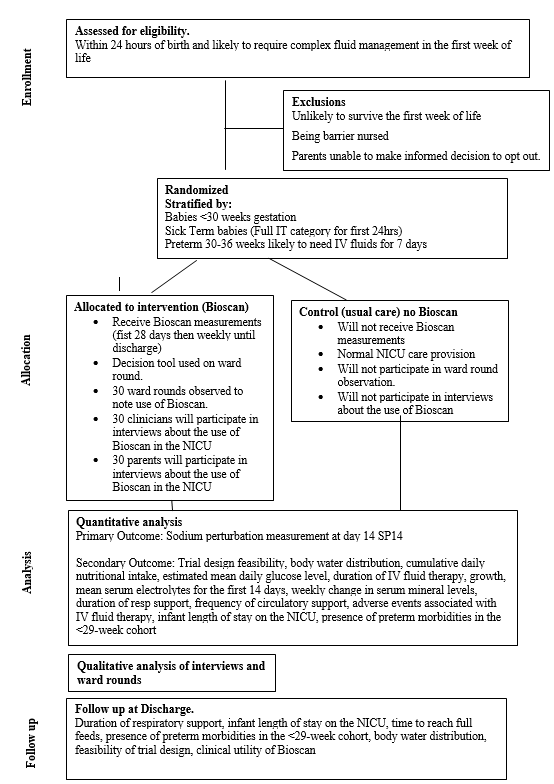
Appendix 3: Guideline Maintenance Fluid Volumes
Appendix 4: Fluid Balance Measurements
Appendix 5: BIA SOP
Please Note – do not carry out scan if baby is feeding or receiving blood products
· Turn ON the Bioscan I8 Touch
· Plug the Red test cable into the red socket on the right of the machine
· Enter user name: **************
For a New Patient
· Select “Standard Test” from the main menu
· The mandatory information page will appear. Input required demographics. These should include: Study ID, height, today’s weight, male/female, gestation and age
· Weight will be measured using the “Giraffe” incubator scales
· Length will be measured using a paper tape measure (average of 3 measurements; head to heel)
· Set the test side to “right” or “left” as appropriate
· Select the “clinical” setting
· Place the infant in the supine position
· Place two electrodes on the hand (dorsal surface of wrist and bottom of 3rd metacarpal)
· Place two electrodes on the foot (anterior surface of ankle and bottom of 3rd metatarsal) using the same side of the body 28. The red plug cable 1 is marked 1-4. Clip cable marked 1 and 2 to the electrodes on the hand and 3 and 4 to the electrodes on the foot

· If the baby is unsettled or crying, cover the baby with a sheet/blanket for containment
· Make sure the baby’s limbs are not touching each other
· When you are ready to start the test press the “standard test” button
· Do not touch the baby while the scan is in progress
For an Existing Patient
· Select “Database” from the main menu
· Select the patient ID from the menu
· Update demographics: Length weekly (Mon), age and weight daily
· Press the “standard test” button
Quality Testing
· Within the database a green smiley emoji illustrates a good quality test
· If a red sad emoji is present, the test should be repeated by using “Edit Input Data”
Appendix 6: Bioscan Clinical Utility Feedback Sheet
Appropriate
Clinical Opinion of Fluid Status
ECF High/Low/Normal/Unknown (Should fall straight after birth. High in oedema) Look at the target diagram/ fluid level baby diagram/ fluid trend graphs)
ICF High/Low/Normal/Unknown (Should see a steady and increasing in good growth /will decrease in times of fluid restriction/dehydration) Look at the target diagram
IVF High/Low/Normal/Unknown (Review BP / Echo findings) Look at the intravascular trend
Interstitial High/Low/Normal/Unknown (Observe for oedema / dehydration) Look at the extravascular trend and the interstitial diagram
Is the clinical picture consistent with the Bioscan data??
(Observe the EVF/IVF trend – does this fit with weight trend? Have you started or stopped diuretics? Have you seen a corresponding change in trend? What is your serum sodium? Does this fit with your overall fluid status? Might be affected by inappropriate supplementation)
Contradicts Bioscan Data, Not interpretable/irrelevant, Consistent with Bioscan data
-1 0 +1
Accessible
Are you able to access Bioscan results? (Are these on the computer? Have they been taken?)
Bioscan readings not available, Not practical for patient, Bioscan working well
-1 0 +1
Adherence
I have referred to the Bioscan data during the ward round/ fluid management decision making
Not looked at Bioscan data, looked but not used , referenced/ added to decision making
-1 0 +1
I have referred to the Bioscan data before/following the ward round when making fluid management decisions
Not looked at Bioscan data, looked but not used , referenced/ added to decision making
-1 0 +1
Practical
Was the baby well enough to have the Bioscan taken?
Unable to use Bioscan on Patient, More than one reading required, Bioscan reading taken easily
-1 0 +1
Reason why Bioscan not taken (Did IV access make taking a reading impractical? Was there a skin injury?) Parent request? Staff decision?)
Short answer
Acceptable - Clinician
(Acceptable to clinicians/ Ethical / Social / Preference about service delivery)
Not acceptable, Mostly Acceptable, Acceptable
SPIRIT 2025 checklist of items to address in a randomized trial protocol*
| Section / Topic | No | SPIRIT 2025 checklist item description | Reported on page no. |
|---|---|---|---|
| Administrative information | |||
| Title and structured summary | 1a | Title stating the trial design, population, and interventions, with identification as a protocol | 31 |
| 1b | Structured summary of trial design and methods, including items from the World Health Organization Trial Registration Data Set | 31–32 | |
| Protocol version | 2 | Version date and identifier | Title Page |
| Roles and responsibilities | 3a | Names, affiliations, and roles of protocol contributors | 31, 41 |
| 3b | Name and contact information for the trial sponsor | Title Page | |
| 3c | Role of trial sponsor and funders in design, conduct, analysis, and reporting of trial; including any authority over these activities | 40–41 | |
| 3d | Composition, roles, and responsibilities of the coordinating site, steering committee, endpoint adjudication committee, data management team, and other individuals or groups overseeing the trial, if applicable | This project is the responsibility of the PI as it forms part of a PhD thesis. Supervision will be provided by the CI. | |
| Open science | |||
| Trial registration | 4 | Name of trial registry, identifying number (with URL), and date of registration. If not yet registered, name of intended registry | 32, 40–41 |
| Protocol and statistical analysis plan | 5 | Where the trial protocol and statistical analysis plan can be accessed | 39 |
| Data sharing | 6 | Where and how the individual de-identified participant data (including data dictionary), statistical code, and any other materials will be accessible | 41 |
| Funding and conflicts of interest | 7a | Sources of funding and other support (e.g., supply of drugs) | 40 |
| 7b | Financial and other conflicts of interest for principal investigators and steering committee members | 41 | |
| Dissemination policy | 8 | Plans to communicate trial results to participants, healthcare professionals, the public, and other relevant groups (e.g., reporting in trial registry, plain language summary, publication) | 40 |
| Introduction | |||
| Background and rationale | 9a | Scientific background and rationale, including summary of relevant studies (published and unpublished) examining benefits and harms for each intervention | 32–33 |
| 9b | Explanation for choice of comparator | 33–34, 37 | |
| Objectives | 10 | Specific objectives related to benefits and harms | 31, 33–34 |
| Methods: Patient and public involvement, trial design | |||
| Patient and public involvement | 11 | Details of, or plans for, patient or public involvement in the design, conduct, and reporting of the trial | 40 |
| Trial design | 12 | Description of trial design including type of trial (e.g., parallel group, crossover), allocation ratio, and framework (e.g., superiority, equivalence, non-inferiority, exploratory) | 33–34 |
| Methods: Participants, interventions, and outcomes | |||
| Trial setting | 13 | Settings (e.g., community, hospital) and locations (e.g., countries, sites) where the trial will be conducted | 36–37 |
| Eligibility criteria | 14a | Eligibility criteria for participants | 34, 36 |
| 14b | If applicable, eligibility criteria for sites and for individuals who will deliver the interventions (e.g., surgeons, physiotherapists) | BIA measurements will be taken by the Nursing Team / PI. Judgements about clinical utility will be provided by all members of the clinical team. | |
| Intervention and comparator | 15a | Intervention and comparator with sufficient details to allow replication including how, when, and by whom they will be administered. If relevant, where additional materials describing the intervention and comparator (e.g., intervention manual) can be accessed | 11-13Appendix 2 |
| 15b | Criteria for discontinuing or modifying allocated intervention/comparator for a trial participant (e.g., drug dose change in response to harms, participant request, or improving/worsening disease) | 38, 39–40 | |
| 15c | Strategies to improve adherence to intervention/comparator protocols, if applicable, and any procedures for monitoring adherence (e.g., drug tablet return, sessions attended) | 38 | |
| 15d | Concomitant care that is permitted or prohibited during the trial | All care as per NICU protocol is permitted during this trial. | |
| Outcomes | 16 | Primary and secondary outcomes, including the specific measurement variable (e.g., systolic blood pressure), analysis metric (e.g., change from baseline, final value, time to event), method of aggregation (e.g., median, proportion), and time point for each outcome | Appendix 1Appendix 2 |
| Harms | 17 | How harms are defined and will be assessed (e.g., systematically, non-systematically) | 40 |
| Participant timeline | 18 | Time schedule of enrollment, interventions (including any run-ins and washouts), assessments, and visits for participants. A schematic diagram is highly recommended (see Figure) | 37–38, 41–43 |
| Sample size | 19 | How sample size was determined, including all assumptions supporting the sample size calculation | 37 |
| Recruitment | 20 | Strategies for achieving adequate participant enrollment to reach target sample size | 37, 39–40 |
| Methods: Assignment of interventions | |||
| Randomization: | |||
| Sequence generation | 21a | Who will generate the random allocation sequence and the method used | 34 |
| 21b | Type of randomization (simple or restricted) and details of any factors for stratification. To reduce predictability of a random sequence, other details of any planned restriction (e.g., blocking) should be provided in a separate document that is unavailable to those who enroll participants or assign interventions | 34 | |
| Allocation concealment mechanism | 22 | Mechanism used to implement the random allocation sequence (e.g., central computer/telephone; sequentially numbered, opaque, sealed containers), describing any steps to conceal the sequence until interventions are assigned | 34 |
| Implementation | 23 | Whether the personnel who will enroll and those who will assign participants to the interventions will have access to the random allocation sequence | 34 |
| Blinding | 24a | Who will be blinded after assignment to interventions (e.g., participants, care providers, outcome assessors, data analysts) | This is not a blinded trial. |
| 24b | If blinded, how blinding will be achieved and description of the similarity of interventions | This is not a blinded trial. | |
| 24c | If blinded, circumstances under which unblinding is permissible, and procedure for revealing a participant’s allocated intervention during the trial | This is not a blinded trial. | |
| Methods: Data collection, management, and analysis | |||
| Data collection methods | 25a | Plans for assessment and collection of trial data, including any related processes to promote data quality (e.g., duplicate measurements, training of assessors) and a description of trial instruments (e.g., questionnaires, laboratory tests) along with their reliability and validity, if known. Reference to where data collection forms can be accessed, if not in the protocol | 37–39, 41–42, 44–46Appendix 1Appendix 5 Appendix 6 |
| 25b | Plans to promote participant retention and complete follow-up, including list of any outcome data to be collected for participants who discontinue or deviate from intervention protocols | Appendix 1 | |
| Data management | 26 | Plans for data entry, coding, security, and storage, including any related processes to promote data quality (e.g., double data entry; range checks for data values). Reference to where details of data management procedures can be accessed, if not in the protocol | 38–39 |
| Statistical methods | 27a | Statistical methods used to compare groups for primary and secondary outcomes, including harms | 39 |
| 27b | Definition of who will be included in each analysis (e.g., all randomized participants), and in which group | 39 | |
| 27c | How missing data will be handled in the analysis | 34 | |
| 27d | Methods for any additional analyses (e.g., subgroup and sensitivity analyses) | N/A | |
| Methods: Monitoring | |||
| Data monitoring committee | 28a | Composition of data monitoring committee (DMC); summary of its role and reporting structure; statement of whether it is independent from the sponsor and funder; conflicts of interest and reference to where further details about its charter can be found, if not in the protocol. Alternatively, an explanation of why a DMC is not needed | This is a single centre trial which forms part of a PhD study by the PI. She is responsible for all data, with expert supervision from the CI and clinical academics. |
| 28b | Explanation of any interim analyses and stopping guidelines, including who will have access to these interim results and make the final decision to terminate the trial | As this is a pilot trial, no interim analysis will be undertaken. | |
| Trial monitoring | 29 | Frequency and procedures for monitoring trial conduct. If there is no monitoring, give explanation | This is a single centre trial and conduct of the trial will be overseen by the PI. She will report to the CI. |
| Ethics | |||
| Research ethics approval | 30 | Plans for seeking research ethics committee/institutional review board approval | 39, 41 |
| Protocol amendments | 31 | Plans for communicating important protocol modifications to relevant parties | 41 |
| Consent or assent | 32a | Who will obtain informed consent or assent from potential trial participants or authorized proxies, and how | 39–41 |
| 32b | Additional consent provisions for collection and use of participant data and biological specimens in ancillary studies, if applicable | This is a standalone study. No further consent processes are needed. | |
| Confidentiality | 33 | How personal information about potential and enrolled participants will be collected, shared, and maintained in order to protect confidentiality before, during, and after the trial | 38–39 |
| Ancillary and post-trial care | 34 | Provisions, if any, for ancillary and post-trial care, and for compensation to those who suffer harm from trial participation | 40 |
References
- 1.World Health Organisation. Recommendations for the care of preterm and low-birth-weight infants. Geneva. WHO
- 3.Kim C, Katheria AC, Mercer JS, Stonestreet BS. Fluid Distribution in the Fetus and Neonate. Fetal and Neonatal Physiology. Fifth Edition ed.; 2017. p. 1081–1089.e3.
- 4.Havinga J, Williams A, Hassan N, Moore S, Dollhopf E, Tumin D, et al. Individualized fluid management in extremely preterm neonates to ensure adequate diuresis without increasing complications. Journal of perinatology 2021 Feb 1;41(2):240–246.
- 5.Weaver LJ, Travers CP, Ambalavanan N, Askenazi D. Neonatal fluid overload—ignorance is no longer bliss. Pediatr Nephrol 2023 Jan 1;38(1):47–60.
- 6.Bell EF, Acarregui MJ, Bell EF. Restricted versus liberal water intake for preventing morbidity and mortality in preterm infants. Cochrane database of systematic reviews 2014 Dec 4;2014(12):CD000503.
- 7.Ågren J, Segar JL, Söderström F, Bell EF. Fluid management considerations in extremely preterm infants born at 22-24 weeks of gestation. Seminars in Perinatology 2022 Feb 1;46(1):151541.
- 8.Thordur, Thorkelsson · Vidar O., Edvardsson· Thordur T., Thordarson Rakel B, Jonsdottir Elin, Ogmundsdottir· Katrin H., et al. Fluid and Electrolyte Management of the Neonate. Current Treatment Options in Pediatrics 2026 Feb;12.
- 9.O'Brien F, Walker IA. Fluid homeostasis in the neonate. Pediatric anesthesia 2014 Jan;24(1):49–59.
- 10.Goyal S, Banerjee S. Fluid, electrolyte and early nutritional management in the preterm neonate with very low birth weight. Paediatrics and child health 2021 Jan;31(1):7–17.
- 11.Kushner RF(oC. Bioelectrical impedance analysis: a review of principles and applications. Journal of the American College of Nutrition 1992 Apr 1;11(2):199–209.
- 12.Kyle UG, Bosaeus I, De Lorenzo AD, Deurenberg P, Elia M, Gómez JM, et al. Bioelectrical impedance analysis—part I: review of principles and methods. Clinical nutrition (Edinburgh, Scotland) 2004 Oct;23(5):1226–1243.
- 13.Kyle UG, Bosaeus I, De Lorenzo AD, Deurenberg P, Elia M, Manuel Gómez J, et al. Bioelectrical impedance analysis—part II: utilization in clinical practice. Clinical nutrition (Edinburgh, Scotland) 2004 Dec 1;23(6):1430–1453.
- 14.Lingwood BE. Bioelectrical impedance analysis for assessment of fluid status and body composition in neonates—the good, the bad and the unknown. European journal of clinical nutrition 2013 Jan 1;67 Suppl 1(1):S28–S33.
- 15.Lingwood BE, Storm van Leeuwen A, Carberry AE, Fitzgerald EC, Callaway LK, Colditz PB, et al. Prediction of fat-free mass and percentage of body fat in neonates using bioelectrical impedance analysis and anthropometric measures: validation against the PEA POD. British journal of nutrition 2012 May 28;107(10):1545–1552.
- 16.Morgan C, Herwitker S, Badhawi I, Hart A, Tan M, Mayes K, et al. SCAMP: standardised, concentrated, additional macronutrients, parenteral nutrition in very preterm infants: a phase IV randomised, controlled exploratory study of macronutrient intake, growth and other aspects of neonatal care. BMC Pediatrics 2011 Jun 10;11(1):53.17. Sandelowski M. What's in a name? Qualitative description revisited. Research in Nursing & Health 2010 Feb;33(1):77–84.
- 17.Doyle L, McCabe C, Keogh B, Brady A, McCann M. An overview of the qualitative descriptive design within nursing research. Journal of Research in Nursing 2020 Aug 1;25(5):443–455.
- 18.SMART A. A multi-dimensional model of clinical utility. International journal for quality in health care 2006 Oct;18(5):377–382.
- 19.McCarter DL, Morgan C, Bray L, Tume L. Evaluation of an Education Programme for Introducing Bioelectrical Impedance Analysis to Neonatal Unit Staff: A Mixed Methods Study. Nursing in critical care 2026 Mar;31(2):e70446–n/a.
- 20.Bradshaw C, Atkinson S, Doody O. Employing a Qualitative Description Approach in Health Care Research. Global Qualitative Nursing Research 2017 Jan;4:2333393617742282.
- 21.Fawcett J, Garity J. Evaluating Research for Evidence-Based Nursing Practice. 1st ed. Philadelphia: F.A. Davis Company; 2009.
- 22.Malterud K, Siersma VD, Guassora AD. Sample Size in Qualitative Interview Studies. Qualitative health research 2016 Nov;26(13):1753–1760.
- 23.Kirkwood BR, Sterne JAC. Essential medical statistics. 2. ed. ed. Malden, Mass: Blackwell Science; 2003.
- 24.Braun V, Clarke V. Using thematic analysis in psychology. Qualitative research in psychology 2006;3(2):77–101.
- 25.Gale C, Hyde MJ, Modi N. Research ethics committee decision-making in relation to an efficient neonatal trial. Archives of Disease in Childhood. Fetal and Neonatal Edition 2017 Jul 1;102(4):F291–F298.
- 26.O'Cathain A, Murphy E, Nicholl J. The quality of mixed methods studies in health services research. Journal of health services research & policy 2008 Apr 1;13(2):92–98.