Abstract
Background
Aging is said to represent a declining state that is possibly especially compromised by sleep issues, and declining melatonin levels.
Aim
This review examined the idea that aging can be favorably influenced in numerous ways by the addition or maintenance of adequate melatonin levels. Specifically, the impact of melatonin on skeletal muscle was the key topic of interest.
Method
Reviewed were peer reviewed research and review articles specifically pertaining to healthy aging, melatonin, and muscle associated observations.
Results
Declining melatonin levels greatly impact multiple essential body systems and tissues. Supplements or interventions that heighten melatonin presence appear to have beneficial impacts on aging in general, and muscle function and structure, in particular.
Conclusion
The use of melatonin early on in the aging process is likely to produce more favorable long-term outcomes than not in cases of deficiency, and should be further investigated.
Author Contributions
Copyright © 2021 Marks R
 This is an open-access article distributed under the terms of the Creative Commons Attribution License, which permits unrestricted use, distribution, and reproduction in any medium, provided the original author and source are credited.
Competing interests
The authors have declared that no competing interests exist.
Citation:
Introduction
Aging is universally associated with poor as well as declining health 1. A novel counter idea, that of healthy aging, has however been proposed as being feasible as well as highly desirable. In particular, discussed for some time in this realm has been the role of melatonin, an intrinsic hormone with multiple endocrine functions, produced in the pineal gland as well as several key body sites, such as bone, and that is a free radical scavenger and strong antioxidant, with powerful anti-inflammatory, and immunosuppressive properties 2, 3, 4, 5 that shows decreases in the course of senescence 6, 7, 8, along with disruptions in extra-pineal tissue sites and their membrane associated melatonin receptor expression 9, 10. As well, studies show an even more pronounced depletion of melatonin in diseases related to insulin resistance, which is common in older adults 11, 12, along with other chronic diseases 13. Based on the findings of multiple clinical and laboratory based studies, melatonin applications do however, appear highly promising for mitigating or reversing many age-related diseases, as well as physical attributes of aging such as frailty that may have some association with abnormal circadian and chronobiological states that impact the release of melatonin 9. Indeed, through its dual preventive and therapeutic effects on many body tissues and systems, as well as diseases, including neurological diseases e.g., Alzheimer's disease, Parkinson's disease, multiple sclerosis, amyotrophic lateral sclerosis, Huntington's disease, epilepsy, headache, etc., melatonin, which exhibits marked antioxidant and anti-aging effects at the level of skeletal muscle 14 must clearly be considered important to examine in the realm of efforts to limit or mitigate adverse secondary and possibly reversible aging effects.
Accordingly, Cardinali 15 has proposed that the presence of adequate melatonin, a somewhat essential chronobiotic and cytoprotective agent, can be expected to foster a healthy, rather than a disease associated aging state due to declining melatonin levels. These include, but are not limited to those such as metabolic syndrome, a variety of ischemic and non-ischemic cardiovascular diseases, neurodegenerative disorders such as Alzheimer's and Parkinson's diseases, as well as possible increases in the risk of falling 16. A hormone possessing several properties, melatonin, which can serve as a direct and indirect antioxidant, as well as a protector and modulator of mitochondrial function, may not only enhance life affirming circadian amplitude impacts, but importantly it may be especially beneficial in advancing neurological as well as musculoskeletal wellbeing in the face of age-associated declining levels 2, 9, 17, 18, 19.
It can also be predicted that even if melatonin production is not disrupted solely by age, it can be impacted negatively by other factors including, lifestyles and environmental factors, whereby exposure to blue lighting sources at night, may disrupt melatonin production in its own right, for example in confined indoor care settings that employ light emitting diode type night lights and electronic devices 1, 20.
Regardless of cause, not only does melatonin impact many body systems adversely if supply is limited, but one of the many health conditions said to be linked to a melatonin deficiency is sarcopenia, an age-related muscle wasting disease that has gradually become a serious health problem for elderly individuals due to its impact on the risk of falls, weakness, and disability 21. However, even though originally studied largely in the context of sleep health, current melatonin studies reveal this hormone has the ability to protect muscle mitochondria, maintain muscle fiber numbers, partially reverse age-associated pathological muscle tissue changes, and increase muscle strength in patients with sarcopenia 21.
As such, this current article discusses melatonin, a highly important multifunctional neuro hormone, and its possible utility for fostering more favorable health status in general, and muscle associated outcomes in later life in particular, than is presently observed, as hypothesized by Cipolla-Neto et al. 18, Jin et al. 21 and others 22. As outlined by Gomes et al. 23, skeletal muscles are responsible for significant disability in the elderly, with sarcopenia being the main alteration. Moreover, muscle, the largest organ in the body, and one that plays a key role in locomotion, insulin resistance, and energy metabolism 24, can surely impact frailty, poor life quality, excess morbidity, and mortality rates in its own right if its physiology is compromised.
Conversely, if aging and its impact on muscle structure and function can be conceived of as a state representing a progressive decline in the synchronicity of key biological processes that impact overall health and functional ability, oxidative stresses and inflammation, it seems plausible to suggest that efforts to maintain or restore the presence of a consistent, stable set of rhythmic molecular, cellular, and systemic level oscillations through melatonin supplementation will likely yield a more favorable aging health state than not, as well as an increased potential for longevity 22, muscle mass preservation 23, muscle regeneration and repair 24, 25, and improvements in the overall circadian system 26. Moreover, as per Obayashi et al. 27, melatonin may have a powerful impact on adverse age associated oxidative and inflammatory muscular interactions. In light of the growing numbers of aging adults worldwide, and their current overall health challenges that are not readily addressed by current medical models to any degree, our present goal was to examine support for the idea that efforts to maximize the presence and effectiveness of melatonin is not only likely to foster more healthy aging than not, but also aging muscle function, a major age associated health concern 14.
Methods
To arrive at a balanced conclusionconcerning melatonin, healthy aging, and/or muscle, every effort was made to examine all relevant findings published in the peer reviewed literature, and located at the PUBMED database, followed by a supplementary search on GOOGLE SCHOLAR and SCIENCE DIRECT to identify any additional relevant materials published in the English language as full length articles. As well, bibliographic resources were examined if they pertained to the present topic. All items that discussed either some aspect of the current topic of interest were deemed of interest to examine.
The search, conducted by the author, was limitedhowever, by excluding studies detailing the link between melatonin and many health issues such as cancer, conference abstracts, preprints, studies focusing on dental or prosthetic implants, oral health, muscle development studies, adolescent based studies, and those that did not directly address the current topics. As well, only papers discussing skeletal muscle relative to aging, as opposed to cardiac or smooth muscle were examined. Among those downloaded for further scrutiny, all forms of research design and procedures were deemed acceptable if they addressed one or more items of specific present interest. After examining the data, it was decided that in light of their diverse study approaches, the data could not be successfully aggregated, thus only a narrative overview of what has emerged to date is reported here. However, even then, the current review does not discuss the metabolic pathways revealed in some studies, or the cell and gene receptors processes that potentially link melatonin effects and muscle tissue and physiology, being mindful that most studies were conducted in vivo or in vitro in the lab and may not ably predict the human situation at all comparably. Also, the animals most studied, rodents, are generally nocturnal, raising some concern over their use for understanding human chronobiology and the processes of melatonin production and influence. The role of mode of melatonin delivery and measurement is also accepted as being optimal in the diverse studies on the topic. Relevant reviews for additional reading are those of Cardenali 15, Chen et al. 24 and Carpentieri et al. 28.
Results
When considering there are clearly many thousands of studies that one can draw on and that discuss the concept of healthy aging, plus numerous citations that appear related to melatonin in its own right, it is surprising that very few studies examine these topics in tandem to any consistent degree. The scope of the research in this regard, is also limited largely to those dealing with sleep issues, diabetes, cardiovascular disease, and immunity, while far fewer investigations examine melatonin and its impact on skeletal muscle, despite the importance of muscle function and structure for health maintenance and wellbeing in later life.
However, given that inflammation is a core element of aging as well as multiple muscle aging processes 29, according to Jin et al. 21, melatoninapplications may be able to simultaneously protect the mitochondria of skeletal muscle cells that control its physiology, while helping to maintain muscle fiber numbers. Moreover, where required, melatonin might help to partially reverse the prevailing pathological changes of ageing muscle tissue, while restoring or increasing muscle strength capacity in cases suffering from sarcopenia, an age-related disease, which may be due in part to an age-dependent decrease in melatonin secretion 29.
Melatonin and its potential for fostering physical health is also supported by evidence that melatonin is a multi-therapeutic agent that can safely reduce skeletal frailty, muscle atrophy, oxidative stresses, inflammatory processes, ischaemic and non ischaemic cardiovascular conditions, viral infections, diabetes, neurological conditions, cognitions, sleep, and physical performance decrements 15, 24, 30. As well, melatonin can effectively prevent apoptotic cell death in skeletal muscle fibers via several mechanisms 31, while protecting against muscle related pain, skeletal muscle injury, and oxidative inflammatory damage, in a dose and/or time dependent manner 15, 32.
Clinically and unsurprisingly, Obayashi et al. 27 who conducted a cross-sectional study of 760 community-based elderly individuals (mean age, 71.0 years) found melatonin secretion was significantly associated with muscle strength in this elderly population. Moreover, in line with findings of Salucci et al. 31 melatonin induced muscle protective effects that were said to include its role in mitigating mitochondrial dysfunction.
Other data show melatonin can mitigate or prevent
Muscle pathological injury 24
Nerve injuries 24
Abnormal muscle metabolic responses 24
Muscle related microvascular impairments 24
Muscle atrophy/destructive processes 24, 25
Muscle pain 32
Periarticular muscle damage 33
Muscle fatigue 34
Post-exercise induced muscle injury 35
Muscle inflammation 36
Extra and intracellular oxidative toxicity 37, 38, 39.
Importantly, this ability to protect muscle from excess damage, which is largely attributable to the favorable impact of melatonin on harmful muscle oxidative processes 37, 38, 39 is said to prevail even in the context of senescent, diseased or radiated muscle tissue 24. Moreover, although disputed by Armstrup et al. 40 following a double-blind placebo-controlled study of 81 postmenopausal women with osteopenia who received 1 or 3 mg melatonin, or placebo nightly for 12 months, with no observable muscle strength in neither upper- nor lower extremities, Obayashi et al. 27 found melatonin secretion was significantly associated with muscle strength in an elderly population.
Additionally, even though Rondanelli et al. 41 found no strength gains in response to melatonin administration in combination with amino acids in an elderly cohort, Stratos et al. 25, found melatonin not only increased the twitch and tetanic force-generating capacity of injured muscle at days 4, 7, and 14 after baseline in an animal muscle injury model, but the melatonin applications also tended to support muscle restoration and enhanced function after the initially crush induced injury. That is, while the muscle injury caused a large initial reduction in its twitch force capacity when compared to that of the control uninjured muscle, the strength of the muscle improved over the 14 days in response to daily applications of melatonin.
Sayed et al. 36 too noted a beneficial outcome in response to oral melatonin administration applied in an animal model of aging muscle. Not only was the normal muscular architecture preserved, but muscle weight, and muscle fiber numbers as well. In addition, it appeared the melatonin applications prevented mitochondrial damage, tubular aggregation, and apoptotic processes in the aging muscles. Taken together, it was concluded that melatonin can favorably impact aging muscle in multiple ways, a finding supported by others in the context of artificially damaged muscles in animal models 33, 42, 43, 44, as well as in association with muscle damage in humans 26. Melatonin also appears to have the potential for regulating muscle regeneration processes 24, increasing the grip force of injured muscle 24, improving muscle healing 24, reducing muscle degenerative processes 24, while fostering general health as well as muscle function in both disabled and aging individuals with severe muscle mass losses, as well as muscle damage 37, injuries, diabetes, and inflammatory diseases 24, 45, 46, 47, 48, 49, 50.
As well, another important fact concerning melatonin and muscle is that the key metabolic pathways involved in muscle, are found to be impacted favorably by melatonin, due to its ability to prevent mitochondrial dysfunction and insulin resistance, while promoting lipid transport 51. Melatonin also appeared to help attenuate muscle atrophy produced by stroke conditions 52, and showed decreases in older adults with sarcopenia, characterized by muscle mass losses and declining motor function 53, 54. Melatonin may hence be highly appropriate for helping to avert or compress a multitude of age-related muscular problems and others 31, 54, while improving functional capacity and energy metabolism that determine life quality perceptions 34, 41, 55, 56, even in the face of aging and the presence of chronic health conditions.
In sum, although data on the topic of melatonin and its skeletal muscle associations are fairly limited as outlined by Chen et al. 24, available evidence points to an important role for melatonin in the context of both healthy aging and mobility maintenance, muscle healing, and function due to its multi-dimensional antioxidant, immunomodulatory, bone cell regulation 9, angiogenesis actions 9 and anti-aging properties 57. In turn, the ability to use muscles more proficiently in the presence of melatonin may be an important anti-aging and life prolonging factor in its own right 58, even though Armstrup et al. 40 found no added value of melatonin on muscle strength in older postmenopausal women, as was the case for adult males 59.
Discussion
The growing older populations worldwide, and the immense challenges these aging individuals may face, has led to discussions about the counter idea of healthy aging and its attainment in efforts to avert immense human and fiscal costs, in spite of evidence that aging is often accepted as a complex multi-factorial process of molecular and cellular decline, that progressively impacts tissue function, causing frailty, susceptibility to disease, and a low life quality. However, even if the idea of ‘healthy aging’ or aging with limited disability, rather than excess disability is not mainstream or accepted as a possibility by all, an increasing body of recent research not only offers powerful insights into the possibility of achieving more visible signs of healthy aging and longevity, but implies it may be possible to ward off structural and functional deterioration within living systems, at least to some degree, or to delay this 60.
At the same time, the possible utility of melatonin, a multidimensional neuro hormone that tends to decline with age 5, even in healthy older persons 8, has been discussed from both an etiological as well as a therapeutic point of view in this regard eg.11. Yet, even though available evidence is generally consistent in viewing melatonin as an important age associated determinant in multiple respects, as observed in 2004 by Karasak et al. 5 available data do not permit any conclusive statements to be made as regards the anti-aging effects of melatonin and its potential for extending normal longevity, years of healthy life, or aspects of this. Its application for purposes of enhancing, protecting, or fostering muscle function under various conditions in particular 24, which has strong support, and is paramount to ensuring late life mobility and wellbeing and limiting disability is rarely discussed in the clinical literature.
This aforementioned due lack of attention is highly surprising because for almost 25 years, or more, and as supported by increasingly sophisticated preclinical studies, melatonin is repeatedly shown to have multiple widespread actions that could potentially either allay, delay, or mitigate multiple analogues of the aging process 57, such as inflammation 24, cell degeneration, declining immunity, circadian and endocrine regulatory effects 61, 62, plus declining overall health and energy, as well as muscle atrophy, damage, and strength loss effects 24, 25, 31, 32, 49, 63, 64. In particular, melatonin may be especially helpful in cases where it is vitally important to foster optimal muscle strength recovery following injury 25, while reducing muscle inflammation 32, and muscle atrophy 52. It may specifically prevent muscle mass decreases, and dysfunction attributable to a wide array of common age-associated health challenges such as
Selected neurological diseases
Cancer treatment impacts
Arthritic conditions
Bone diseases
Obesity
Cardiovascular conditions
Diabetes
Hyperthyroidism
Sarcopenia
Cognitive deficits
Peripheral nerve injuries
Muscle disorders and injuries 21, 24, 63, 65.
Alternately, a failure to consider the role of melatonin and its widespread influence on body physiology, can predictably induce a wide array of secondary possibly reversible aging outcomes as conceptualized in Figure 1. As well, a failure to screen aging adults for melatonin from an early age, along with efforts to optimize this, as needed, may greatly impact overall health status, profoundly, negatively, and in multiple ways.
Figure 1. Hypothetical interactions of aging, melatonin production declines, and disability, in the context of older adults that stresses a need for early intervention to exert some control over this cascading set of degenerative health outcomes 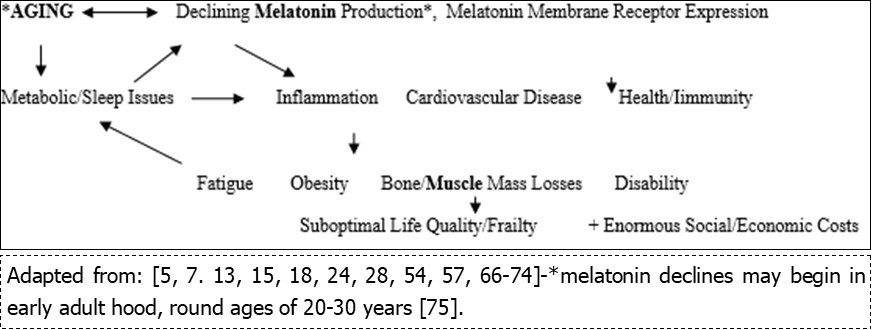
In essence, as implied more than 25 years ago by Huether 76, there are strong grounds in our view, based on the above data, in favor of continuing to examine the possible protective role of melatonin in fostering health outcomes across the lifespan, including muscle health, and muscle oxidative processes and mitochondrial integrity 21, as supported by a number of current researchers eg.5, 15, 30, 35, 44, 53, 77, 78. The influence of declining melatonin levels and melatonin receptor alterations across the lifespan also warrants study in this regard. Indeed, in light of the remarkable promise of melatonin in the context of aging and health maintenance, frailty, falls risk, and muscle weakness alone, a significant return on such an investment can undoubtedly be anticipated with a high degree of confidence, when compared to the costs of failing to act.
Conclusions
Pending more extensive research, we currently conclude:
Aging, a state commonly considered to represent the onset of irreversible disability and declining function, may be amenable to multiple favorable impacts on both human physiology, as well as on genetic programming, neurology, and vulnerability to a variety of random environmental hazards, consequent to efforts to foster optimal melatonin availability and uptake.
Preventable deficits in melatonin production are likely to ensure aging adults are more able to age more healthily on a variety of levels than not, if they can maintain optimal melatonin levels across the lifespan.
The utility of melatonin appears especially indicated for averting, deferring, or reducing the extent of multiple age-associated chronic diseases, lethal viral infections, falls injuries, and frailty, and hence clearly warrants more study, as well as clinical consideration, and possible careful application in selected cases.
Examining the specific role of melatonin in fostering intrinsic regenerative processes, including muscle regeneration, plus its diverse metabolic effects, among others, alongside strategies to offset its decline, while heightening its intrinsic production and uptake in the elderly, including exogenous melatonin supplementation, light therapies, plus behavioral and nutrition intervention is suggested. Indeed, all appear most promising and worthy and deserving of consideration in any meaningful and concerted effort to deliver a bold and compelling body of thoughtful groundbreaking clinical research to promote healthy aging.