Abstract
Extratropical cyclones are common in the South Atlantic. They generally arise with the passage of cold fronts to the south of the South American continent, crossing the south of Chile and Argentina, in the regions of Puerto Natales, Punta Arenas (Chile), Rio Galegos, Rio Grande, El Calafate and Ushuaia (Argentina). The extratropical cyclone analyzed presented at its peak the very characteristic shape of a Chinese dragon. Other cyclones in the form of a Cote's spiral curve are part of this analysis (Gobato et al., 2018-2023). They present a mathematical form of a double Cotes Spiral curve. Here called the Dragonhead cyclone, indicate a structural similarity with spiral galaxies, especially NGC 5247, in the constellation Virgo. With an area of influence and a size of around 3,247 thousand km2 at its peak, it moved quickly in a west-northwest (WNW) direction, with an average speed of 76 km/h, with winds of 84 km/h at 100 km from the nucleus, as it passed north of the Falkland Islands (Malvinas Islands). The cyclone temperature during its trajectory varies from -45ºC to -50ºC at its edge, while at its core it varies between -10ºC to -25ºC.
In the data collected (Gobato et al., 2018-2023), and analyzed from the Dragonhead cyclone, it is clear that all extratropical cyclones that appear south of the South American continent, below 40° latitude, have the shape of a spiral curve, like the spiral galaxy. Most of these are in the form of a double Cote’s spiral curve.
Author Contributions
Academic Editor: Sasho Stoleski, Institute of Occupational Health of R. Macedonia, WHO CC and Ga2len CC.
Checked for plagiarism: Yes
Review by: Single-blind
Copyright © 2024 Ricardo Gobato, et.al
 This is an open-access article distributed under the terms of the Creative Commons Attribution License, which permits unrestricted use, distribution, and reproduction in any medium, provided the original author and source are credited.
Competing interests
The authors have declared that no competing interests exist.
Citation:
Introduction
Cyclone
A cyclone is a large air mass that rotates around a strong center of low atmospheric pressure, counterclockwise in the Northern Hemisphere and clockwise in the Southern Hemisphere as viewed from above (opposite to an anticyclone). 1, 2, 3, 4, 27, 29 Subtropical cyclone is a weather system that can form between the equator and the 50th parallel. 1, 5, 6, 7, 8, 9, 26, 27 These storms usually have a radius of maximum winds that is larger than what is observed in purely tropical systems, and their maximum sustained winds have not been observed to exceed about 32 m/s (64 knots). Subtropical cyclones in the Atlantic basin are classified by their maximum sustained surface winds: Subtropical depressions have surface winds less than 18 m/s (35 knots), while subtropical storms have surface winds greater than or equal to 18 m/s. 9, 10, 11, 12, 13, 14, 15, 16, 17, 18, 19, 20, 21, 26, 27, 28, 29, 39
Tropical cyclones are compact, circular storms, generally some 320 km (200 miles) in diameter, whose winds swirl around a central region of low atmospheric pressure. The winds are driven by this low-pressure core and by the rotation of the Earth, which deflects the path of the wind through a phenomenon known as the Coriolis force. As a result, tropical cyclones rotate in a counterclockwise (or cyclonic) direction in the Northern Hemisphere and clockwise (or anticyclonic) direction in the Southern Hemisphere. .9, 10, 11, 12, 13, 14, 15, 16, 17, 18, 19, 20, 21, 26, 27, 29, 39
NGC 5247 Spiral Galaxy
Spiral galaxies 40, 41, 42, 43 form a class of galaxy originally described by Edwin Hubble in his 1936 work The Realm of the Nebulae and, as such, form part of the Hubble sequence. Most spiral galaxies consist of a flat, rotating disk containing stars, gas and dust, and a central concentration of stars known as the bulge. These are often surrounded by a much fainter halo of stars, many of which reside in globular clusters54
Spiral galaxies are named by their spiral structures that extend from the center into the galactic disc. The spiral arms are sites of ongoing star formation and are brighter than the surrounding disc because of the young, hot OB stars that inhabit them 42, 43, 47, 54.
The (Figure 1) shows NGC 5247, a grand design barred spiral galaxy, located 60–70 million light-years away. The galaxy lies face-on towards Earth, thus providing an excellent view of its pinwheel structure and multiple arms. It is in the zodiacal constellation of Virgo (the Maiden) 55.
Figure 1. HAWK-I image of NGC 5247 Galaxy.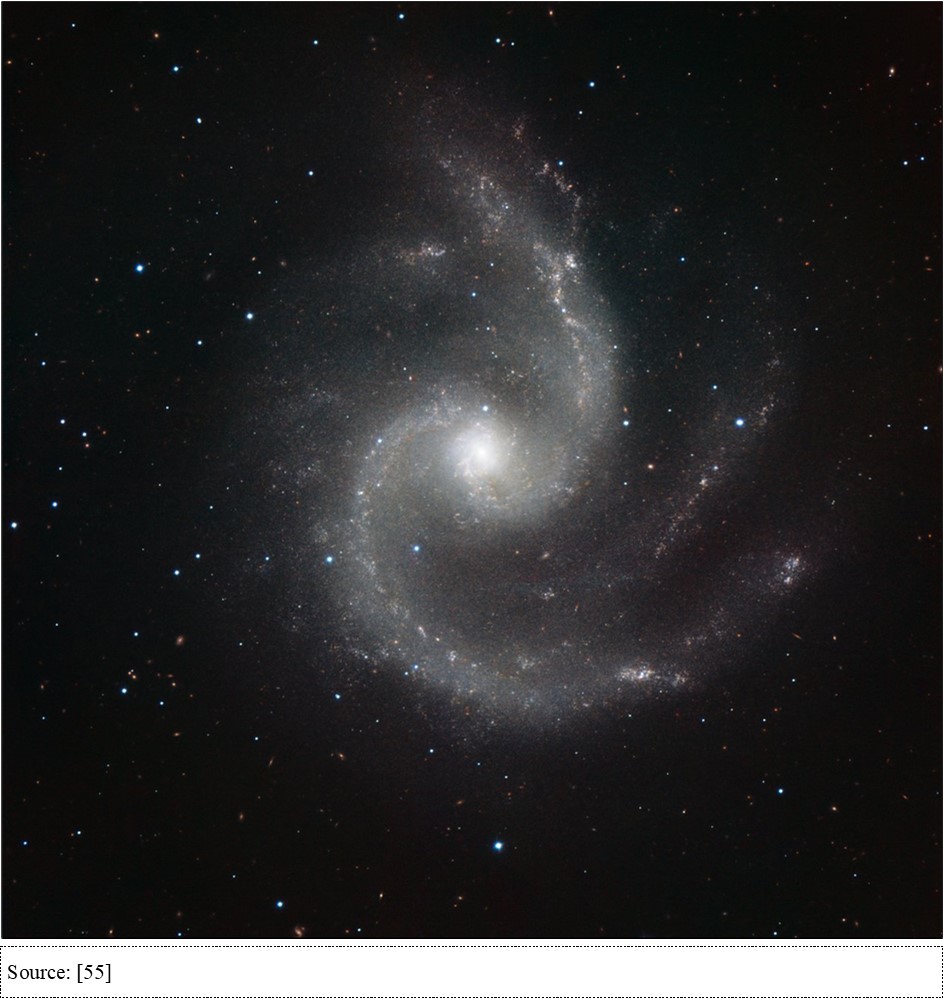
The image was made in infrared light with the HAWK-I camera on ESO’s Very Large Telescope at Paranal Observatory in Chile. HAWK-I is one of the most powerful infrared imagers in the world, and this is one of the sharpest and most detailed pictures of this galaxy ever taken from Earth. The filters used were Y (shown here in blue), J (in light blue), H (in green), and K (in red). The field of view of the image is about 6.4 arc minutes. 55
NGC 5247 is a face-on unbarred spiral galaxy located some 60 million light years away in the constellation Virgo. It is a member of the Virgo II Groups, a series of galaxies and galaxy clusters strung out from the southern edge of the Virgo Super cluster. This grand design spiral galaxy displays no indications of distortion caused by interaction with other galaxies. It has two spiral arms that bifurcate after wrapping halfway around the nucleus. The disk is estimated to be 4.9 ± 2.0 kly (1.5 ± 0.6 kpc) in thickness and it is inclined by roughly 28° to the line of sight. 56
Cote’s spiral
Development
After an analysis of the different types of spirals 29, 30, 31, 32, 33, 34, 35, 36, it was concluded that the form that came closest the spiral, (Figure 1, Figure 2, Figure 4, Figure 5, Figure 6), is a double Cotes's Spiral, for the case  , (Figure 2) 26.
It was determined the mathematical equation of the shape of the Dragonhead cyclone, in the shape of a spiral called Cotes's Spiral", for the case , (Figure 2) 24, 25, 26.
A spiral that gives the solution to the central orbit problem under a radial force law
 (1)
(1)
where µ is a positive constant. There are three solution regimes,
 (2)
(2)
where  , when ,
where A and ɛ are constants, and h is the specific angular momentum 26, 37, 38.
Analyzing the shape of the Spiral shape called "Cotes’s Spiral" for 24, 25, it appears that adding two constants to Equation (2) makes the necessary adjustments for the Isobaric ones. In the case of Dragonhead cyclone, the spiral that gives the solution to a radial force law is given by Equation (1).
An adjustment in Equation (2) is necessary to obtain the graph of (Figure 7). Then, adding the constants
 and C where for .
The equation is defined for the Dragonhead Cyclone:
 (3)
(3)
The Software for creating the graphics was Origin Lab evaluation version 2018, (Figure 6). 63
For calculations the computer used a Desktop with SUSE Linux Enterprise Desktop 64, AMD Ryzen 7 1800X processor 65, ASUS Prime A320M-K motherboard 66, 16GB of RAM, with 500GB SSD 67.
(Figure 4) and (Figure 5) were used to determine the speed, atmospheric pressure, temperature, dimensions of the Dragonhead cyclone.
Analysis and Results
With winds coming from the Pacific Ocean, the cold front crosses southern Chile and Argentina. Forming from the region of Puerto Natales, Punta Arenas (Chile), El Calafate, Rio Galegos, Rio Grande and Ushuaia (Argentina), as shown in (Figure 4), 4h UTC on February 7, 2024. The cold coming from the Pacific collides with a mass of hot air coming from the north of the province of Santa Cruz and central-south of Chubut.
On February 7, 2024 at 18:00 UTC, the cyclone reached an area of influence of 3,247 thousand km2. It had a head/neck of elliptical dimensions measuring 639 km by 552 km, whose core was located at 45°36'S, 21°31'W, north of the Falkland Islands. With winds of 84 km/h, it had already traveled 640 km in 10 hours, with an average of 64 km/h, according to the analyzes and measurements in (Figure 4, Figure 5, Figure 6).
The variation in temperature and water sality were not studied in the work, leaving their influence on the formation of cyclones in the region for later studies. As for the cyclone temperature during its formation, (Table 1) varies from -45ºC to -50ºC at its edge, while at its core it varies between -10ºC to -25ºC.
It had a pressure of 978 hPa, February 7, 2024 at 08:00 am (UTC), 100 km north of the nucleus (Figure 5), with winds of 76 km/h, with a nucleus at 970 hPa. Taking off in the WNW direction.
It appears that the spiral shape of the Dragonhead is very similar to the shape of the spiral galaxy NGC 5247, presenting the same shape. The analogous shape of Dragonhead cyclone and the NGC 5247 Galaxy, studied here is clear. These present a double Cote's spiral. Studied by Lindblad47, but with the Cote’s spiral form, (Gobato et al. 2022) 8, 9, 11.
The (Figure 2) show shapes of curves called Cote's spiral gives the solution to the central orbit problem.
Figure 2. Shapes of curves called Cote's spiral gives the solution to the central orbit problem, where the radial force has the form equation (1).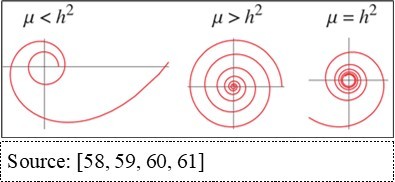
The (Table 1) shows the coordinates of Dragonhead cyclone, February 07, 2024, am/pm, a central vortex pressure of 951 hPa, with an approximate dimension of 10 km.
Table 1. Dragonhead cyclone coordinates/Pressure/Temperature, in accordance with the analyzes and measurements in Figures (4) and (7).| February 7, 2024 | Coordinates | Pressure ( hPa ) | Temperature (ºC) |
| 08:00 am (UTC) | 52°46’08”S 67°49’48”W | 978 | -50 |
| 06:00 pm (UTC) | 51°33’22”S 65°14’24”W | 970 | -45 |
The (Figure 3) shows isobaric and wind lines at 500 m height, in the south of the American continent.
Figure 3. The Figure shows isobaric and wind lines at 500 m height, in the south of the American continent.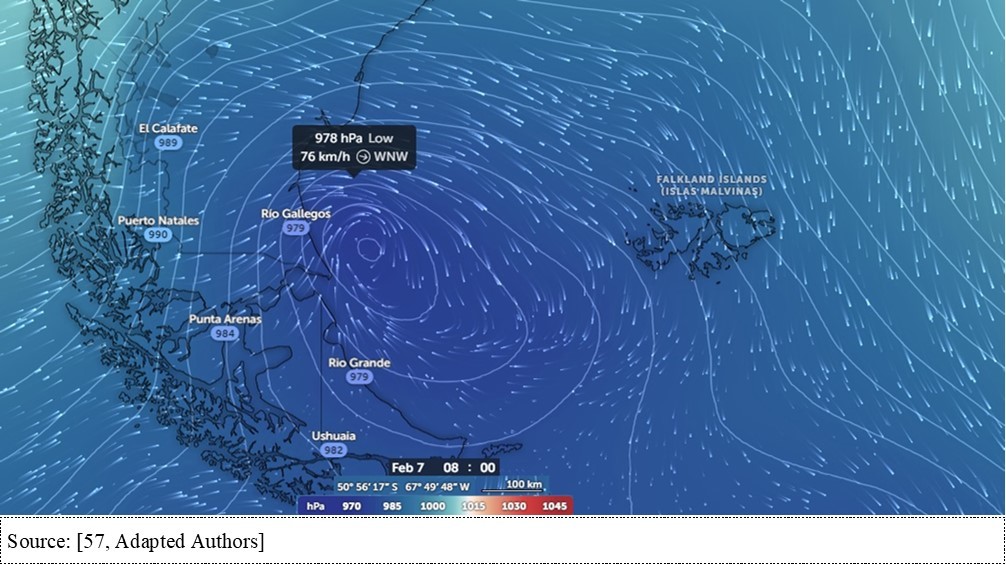
The pressure at 500m height in the cities of El Calafate, Puerto Natales, Ushuaia, Rio Grande, Rio Galegos, are 989, 990, 984, 982, 979 and 979 hPa, respectively. In the Falkland Islands (Malvinas Islands) it is between 984 and 990 hPa.
The (Figure 4) and (Figure 5) show the trajectory of the dragonhead cyclone between 08:00 am (UTC) and 06:00 pm, February 7, 2024.
Figure 4. Image of the Dragonhead cyclone, at 8 am (UTC), February 7, 2024.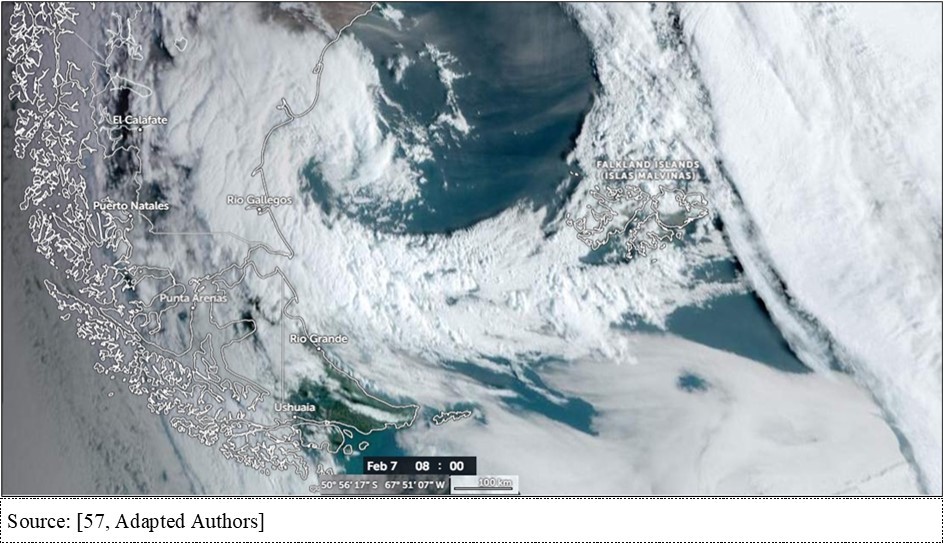
Figure 5. Image of the Dragonhead cyclone, at 6 pm (UTC), February 7, 2024.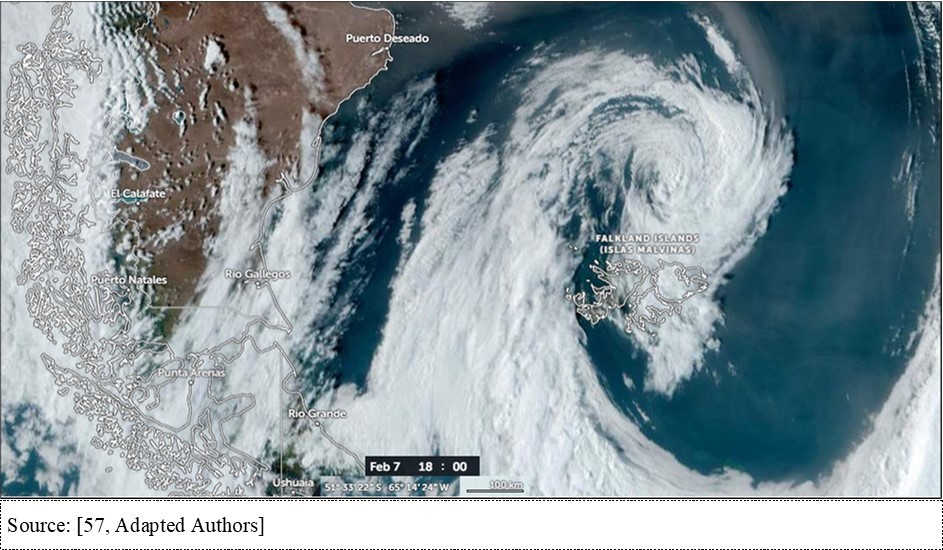
The (Figure 6) it represents the dimensions of the points collected from (Figure 5), in km, using the Isobaric 30, 31 found in (Figure 3, Figure 4, Figure 5).
Figure 6. Graphic plot of the dimensions and shape of the Dragonhead cyclone, as at 18 am (UTC), February 7, 2024.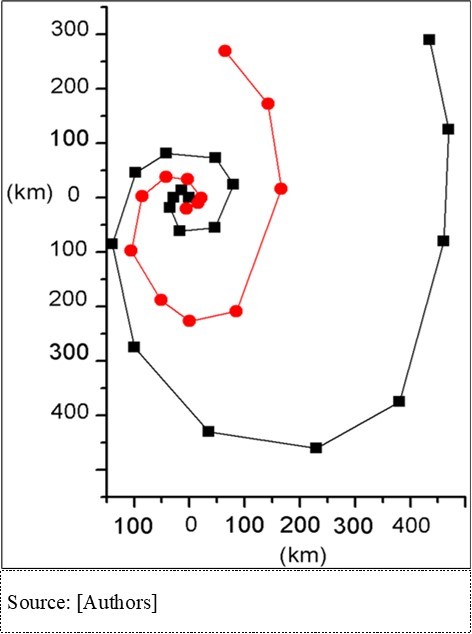
The (Figure 7) show the cyclone temperature during its trajectory, (Table 1), varies from -45ºC to -50ºC at its edge, while at its core it varies between -10ºC to -25ºC.
Figure 7. Image of atmospheric temperature at 500m altitude of the Dragonhead cyclone, 8:10 am (UTC) at 6:10 pm (UTC), February 7, 2024.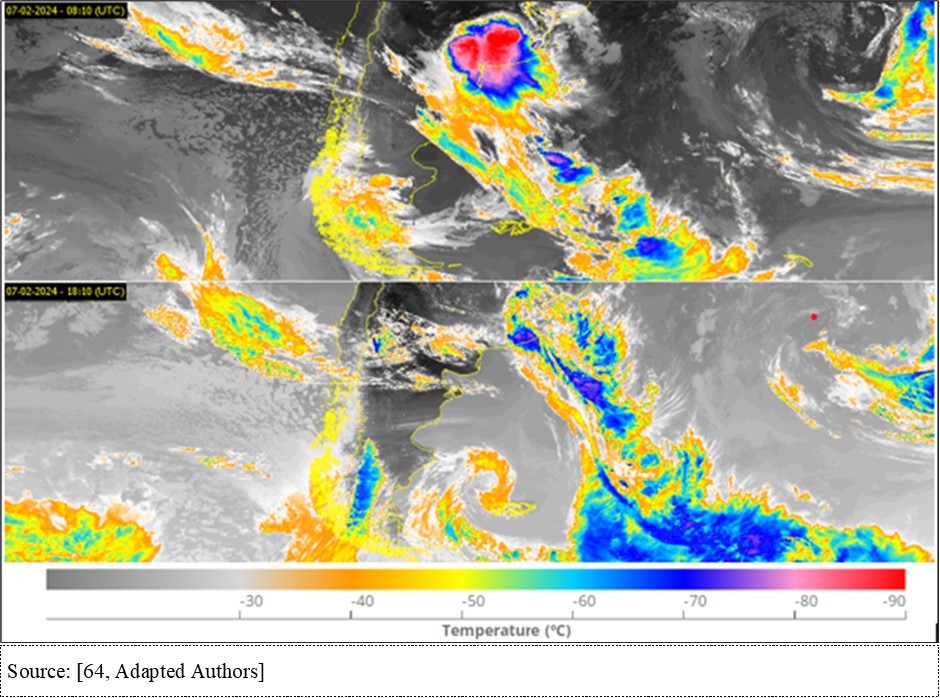
Other spiral galaxies, vortex storms, have also been analyzed 48, 49, 50, 51, 52, 53.
Conclusions
Extratropical cyclones are common in the South Atlantic. They generally arise with the passage of cold fronts to the south of the South American continent, crossing the south of Chile and Argentina, in the regions of Puerto Natales, Punta Arenas (Chile), Rio Galegos, Rio Grande, El Calafate, and Ushuaia (Argentina). The extratropical cyclone analyzed, presented at its peak the very characteristic shape of a Chinese dragon. Mathematical analysis of the way the cyclone pressure curve behaves is that of a double Cotes's Spiral. Here called the Dragonhead cyclone, indicate structural similarity with spiral galaxies, especially NGC 5247, in the constellation Virgo. With an area of influence and a size of around 3,247 thousand km2 at its peak, it moved quickly in a WNW direction, with an average speed of 76 km/h, with winds of 84 km/h at 100 km from the nucleus, as it passed north of the Falkland Islands (Malvinas Islands).
In the data collected 6, 7, 8, 9, 10, 11, 12, 13, 14, 15, 16, 17, 18, 19, 20, 21 and analyzed from the Dragonhead cyclone, it is clear that all extratropical cyclones that appear south of the South American continent, below 40° latitude, have the shape of a spiral curve, like the spiral galaxy. Most of these are in the form of a double Cote’s spiral curve.